
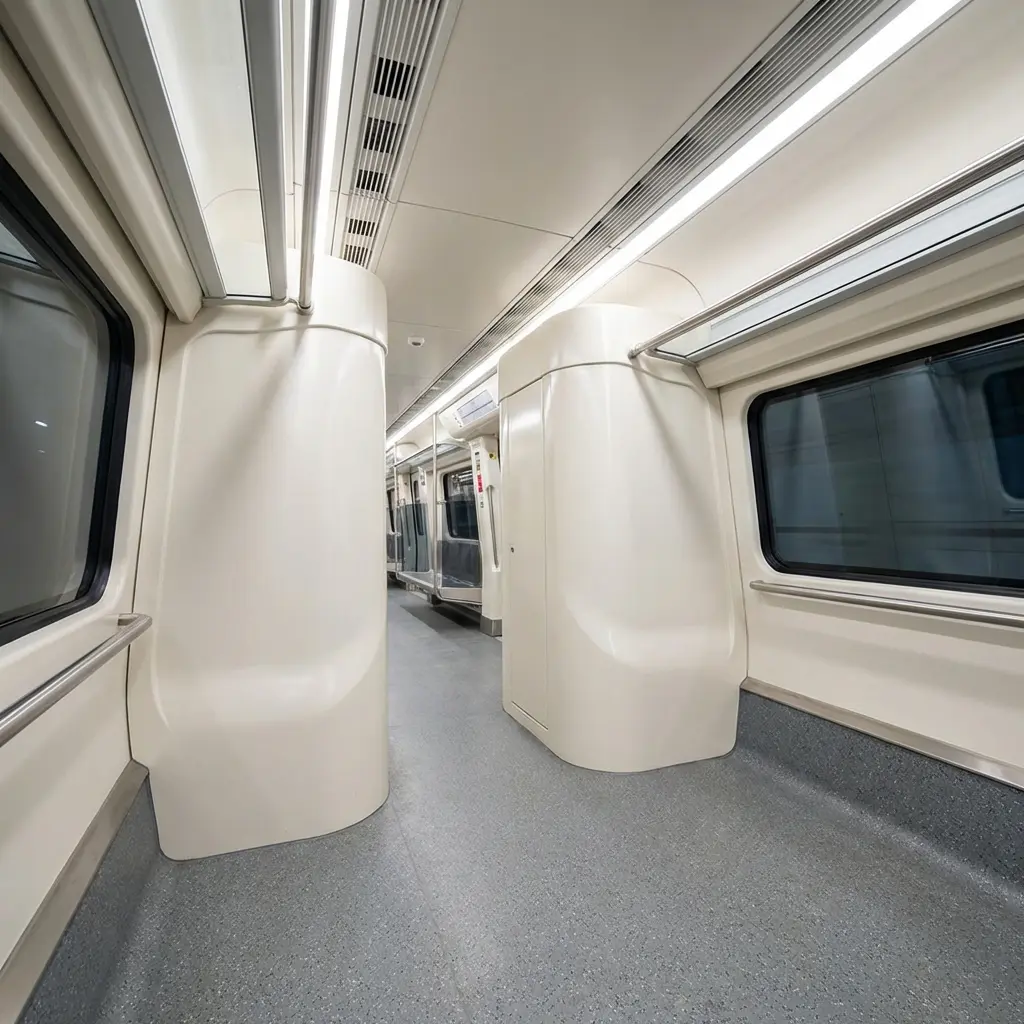
EN 45545-2 Fire Safety Guide: Rail Interior Plastics vs Composites
EN 45545-2 is the harmonised European standard for the fire behaviour of materials and components used in railway vehicles. If you supply interior panels, seating, flooring or structural composites for metro, high-speed rail or trams, understanding EN 45545-2 is the difference between a certified product and a rejected batch. This guide explains the standard in plain engineering language, compares rail interior plastics with flame-retardant composites, and shows how EN 45545-2 HL2/HL3 (Brandschutz 45545) is achieved in practice.
What is EN 45545-2?
EN 45545 (Railway applications — Fire protection on railway vehicles) is the EU-wide standard that replaced national standards such as DIN 5510-2 (Germany), NF F 16-101 (France) and BS 6853 (UK). Part 2 (EN 45545-2:2020) defines the fire behaviour requirements for materials and components, and it became the mandatory benchmark for rolling stock suppliers across Europe and most export markets.
The standard works in two dimensions: the hazard level of the vehicle operation (HL1/HL2/HL3) and the requirement category of the component (R1-R26). Every material must be tested and classified against the specific combination that applies to its application and location.
Hazard Levels: HL1, HL2 and HL3
The hazard level reflects how much time passengers and crew need to evacuate a vehicle in a fire:
• HL1 — vehicles operating mostly above ground, where evacuation is fastest (e.g. commuter trains on open track).
• HL2 — vehicles that spend time in tunnels or where evacuation is slower (e.g. most metro and regional trains).
• HL3 — vehicles operating predominantly in long tunnels with limited egress (e.g. high-speed rail on long tunnel sections, cross-border tunnel routes).
HL3 is the strictest level. Specifying HL3-compliant materials from day one future-proofs a design across operators, because HL3 materials automatically satisfy HL1 and HL2 requirements.
Requirement Categories R1-R26 and FST Performance
Each component in a railway vehicle belongs to a requirement category. The most common ones for composite suppliers are:
• R1 — interior linings (ceilings, wall panels, partitions) — the category our railway composite panels are tested to.
• R7 — seating (frames, cushions).
• R8 — luggage racks and structural interior components.
• R10 — windows, R11 — doors, R17 — floors.
Testing covers the full FST spectrum: flame spread and heat release (EN ISO 5660-1 cone calorimeter, EN ISO 5658-2), smoke density (EN ISO 5659-2), smoke toxicity (EN 45545-2 Annex B / NF X70-100), plus oxygen index (ISO 4589-2). Achieving HL2/HL3 R1 requires low peak heat release, low smoke production and tight toxicity limits — which is exactly where engineered glass-fibre composites outperform traditional rail interior plastics.
Rail Interior Plastics vs Flame-Retardant Composites
Conventional rail interior plastics (ABS, PVC, standard polycarbonate) often fail modern EN 45545-2 requirements because of high heat release and dense, toxic smoke. Continuous-fibre composites solve this at the material level:
• Fibre architecture — multiaxial and quadraxial glass-fibre NCF provides structural rigidity, so flame-retardant resin systems can be used without sacrificing stiffness.
• Resin systems — flame-retardant vinyl ester or phenolic matrices deliver the FST performance required for HL2/HL3 R1.
• Core engineering — PP honeycomb or foam-core sandwich construction cuts weight by up to 30% versus solid plastic panels while improving rigidity.
The result is a panel that meets EN 45545-2 HL2/HL3, reduces vehicle mass, and resists impact and moisture far better than plastic alternatives.
Common Compliance Mistakes
1. Assuming 'flame retardant' means EN 45545 compliant — FR additives alone do not guarantee the smoke density and toxicity limits required by EN 45545-2.
2. Testing the wrong category — an R1 rating does not automatically cover R7 seating; confirm the requirement category for every application.
3. Ignoring the assembly — fasteners, adhesives and edge treatments affect the fire behaviour of the assembled component, not just the raw laminate.
4. HL1-only validation — operators increasingly demand HL2/HL3; validate to the strictest level you may ever need.
How Zhongjie Supports EN 45545-2 Compliance
Zhongjie supplies flame-retardant ECR-glass NCF reinforcements and PP-core sandwich composite panels engineered for railway interiors. Our materials are validated against EN 45545-2 HL2 and HL3 for R1, R2 and R7 requirements, and our technical team supports OEMs and tier suppliers with laminate design, test planning and documentation for the full FST qualification process.
Explore our railway solution for laminate data, resin compatibility and panel specifications.
More Technical Guides
Flame Retardant Battery Enclosures: Composites vs Aluminium vs Steel
Material guide for flame retardant battery enclosures and composite battery trays — aluminium vs steel vs glass-fibre composites, UL94 V-0 / GB 38031 / IEC 62619 fire standards, HP-RTM process, and weight comparison.
CIPP Liner Materials Guide: UV CIPP, Repair Fabrics and Wet-Out
Engineering guide to CIPP liner materials for trenchless pipe rehabilitation — UV CIPP fiberglass, CIPP repair fabrics, ECR-glass wet-out, DN200-DN3000 liners, DIN EN ISO 11296-4 and ASTM F1216.
UAV Composite Materials Guide: Fuselage, Wings and NCF Fabrics
UAV composite material selection guide for drone fuselages, wings and airframes — ±45° biaxial NCF vs woven roving, carbon/glass hybrids, vacuum infusion and weight vs torsion stiffness.
Frequently Asked Questions
What is EN 45545-2:2020?
EN 45545-2:2020 is the European harmonised standard specifying fire behaviour requirements for materials and components in railway vehicles. It replaced national standards like DIN 5510-2 and BS 6853, and defines requirements based on hazard level (HL1-HL3) and component category (R1-R26).
What is the difference between HL2 and HL3?
HL3 is the strictest hazard level, applied to vehicles operating predominantly in long tunnels with limited evacuation options. HL2 covers vehicles with moderate tunnel operation. HL3-compliant materials automatically satisfy HL1 and HL2 requirements, making them the safest specification choice.
Which requirement categories apply to interior composite panels?
Ceilings, wall panels and partitions typically fall under R1. Seating is R7, luggage racks R8, floors R17. Each category has specific heat release, smoke density and toxicity limits, so confirm the category for your exact application.
Can fiberglass composites really meet EN 45545 HL3?
Yes. Engineered multiaxial glass-fibre NCF combined with flame-retardant vinyl ester or phenolic resins and lightweight cores achieves HL2/HL3 R1 FST performance, while offering a weight saving of up to 30% versus traditional rail interior plastics.
Which national standards did EN 45545 replace?
EN 45545 replaced DIN 5510-2 (Germany), NF F 16-101 (France), BS 6853 (UK), UNI CEI 11170 (Italy) and other national railway fire standards across Europe. In German specifications it is commonly referred to as Brandschutz 45545.
What is replacing rail interior plastics in trains?
Rail interior plastics such as ABS, PVC and standard polycarbonate are being replaced by flame-retardant glass-fibre sandwich composites. These panels meet EN 45545-2 HL2/HL3 FST limits, cut mass by up to 30%, and keep structural rigidity that conventional rail interior plastics lose when heavily loaded with flame-retardant additives.