
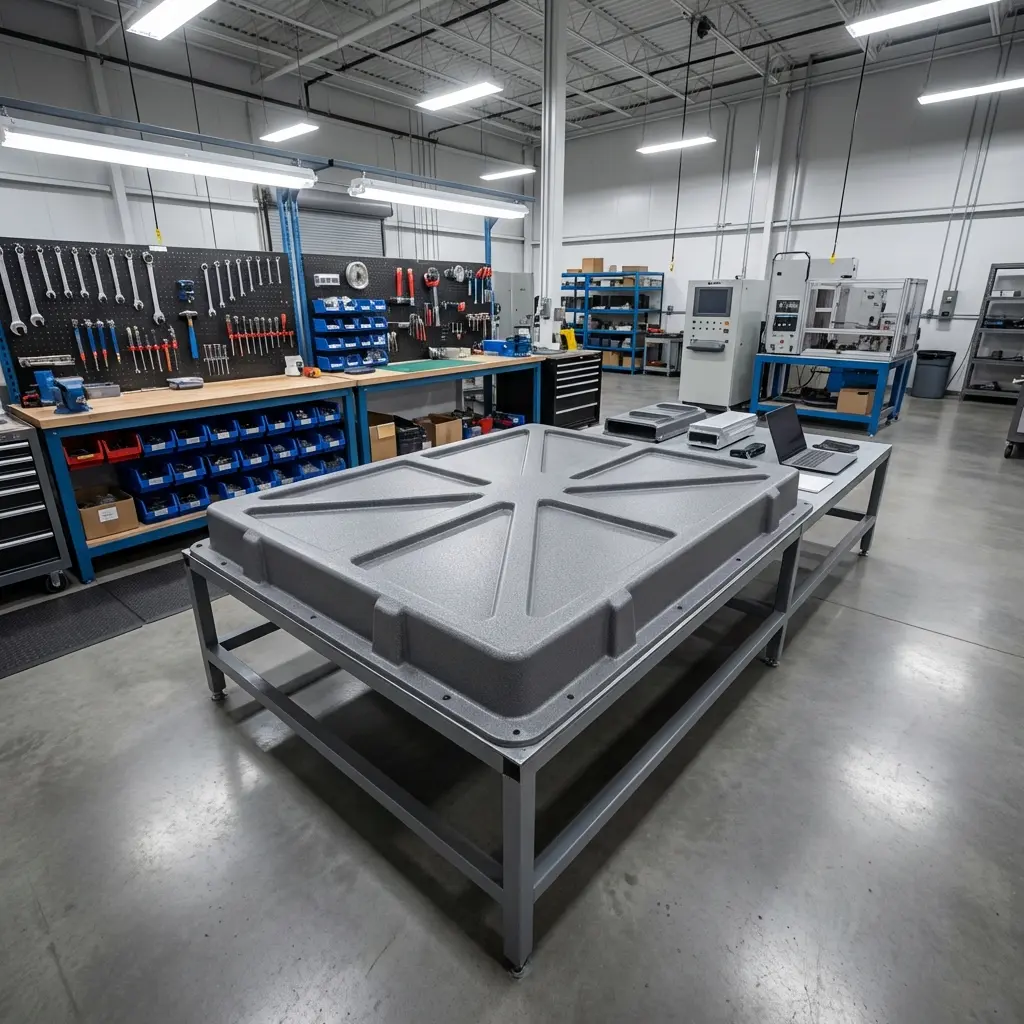
Flame Retardant Battery Enclosures: Composites vs Aluminium vs Steel
The battery enclosure is the EV's most safety-critical structural component: it must contain thermal runaway, absorb crash energy, resist corrosion and stay dimensionally stable for the life of the vehicle — all while being as light as possible. This guide compares aluminium, steel, SMC and continuous-fibre glass composites for battery trays and covers, and explains why flame retardant battery enclosures in continuous-fibre composite are winning the engineering trade-off.
Why Flame Retardant Battery Enclosures Matter
A battery pack enclosure does four jobs: structural protection (crash, vibration, stone impact), thermal management containment, electrical insulation, and sealing against moisture and contamination. Material selection drives pack mass, cost, safety certification and vehicle range. With battery packs weighing 300-600 kg, every kilogram saved on the enclosure translates directly to range or cost.
Fire safety is the deciding factor. Regulatory standards now require enclosures to contain and withstand thermal runaway events without propagating fire to the vehicle cabin.
Material Comparison: Aluminium, Steel, SMC and Glass-Fibre Composites
• Aluminium — light and strong, but electrically conductive (requires insulation liners), expensive to form at high volume, and susceptible to galvanic corrosion with steel fasteners.
• High-strength steel — lowest material cost and best crash performance, but heavy; adds 30-50% more mass than aluminium for equivalent stiffness.
• SMC (sheet moulding compound) — cheap and electrically insulating, but brittle, prone to warpage, and difficult to make flame-retardant at UL94 V-0 with consistent quality.
• Continuous-fibre glass composites (NCF + flame-retardant resin) — up to 40-50% lighter than steel, electrically insulating, corrosion-proof, and tunable: fibre orientation is engineered per load path (0°/±45°/90° quadraxial layups).
The table below summarises the trade-off for a typical 300 kWh-class pack tray.
Fire Standards and Thermal Runaway Requirements
Battery enclosure materials are tested against a growing set of safety regulations:
• UL94 V-0 — the benchmark for flame retardancy of plastics and composites (vertical burn test, self-extinguishing within 10 s).
• GB 38031-2020 — China's mandatory safety requirement for traction batteries, including thermal propagation tests where the enclosure must contain a triggered cell failure for at least 5 minutes.
• IEC 62619 / UN ECE R100 — international cell- and vehicle-level safety requirements covering thermal runaway and fire containment.
Composite enclosures meet these standards by combining flame-retardant resin chemistry (e.g. flame-retardant vinyl ester, often with fillers such as ATH) with continuous glass reinforcement that maintains structural integrity during and after the fire event.
Manufacturing: HP-RTM and Compression Moulding
High-volume enclosure production uses two complementary processes:
• High-Pressure RTM (HP-RTM) — quadraxial NCF preforms are injected with fast-curing resin at high pressure, producing cycle times of 3-8 minutes with excellent surface quality and fibre volume fraction. Ideal for covers and complex-geometry trays.
• Compression moulding — with glass mat or stitched fabrics, offering the lowest cycle times for large flat panels.
Quadraxial NCF (0°/±45°/90° stacks) is the reinforcement of choice because it matches multi-directional load paths in a single ply, minimising layup time and fibre waste versus woven rovings.
Design Considerations for Composite Battery Trays
1. Fibre architecture — use quadraxial or triaxial NCF to handle crash loads from multiple directions without delamination-prone cross-ply stacking.
2. Areal weight — typical enclosures use 600-1500 gsm quadraxial stacks; heavier stacks for the tray base, lighter for the cover.
3. Resin system — flame-retardant vinyl ester balances UL94 V-0 with toughness; add ATH filler for thermal runaway resistance.
4. Integration — composite enclosures can co-mould brackets, ribs and sealing surfaces, removing dozens of fasteners and sealing joints.
5. EMI shielding — where shielding is required, a thin metal mesh or coated layer can be co-laminated with the composite.
Zhongjie's Composite Battery Enclosure Solution
Zhongjie supplies custom quadraxial NCF (EQX series, 600-1500 gsm) engineered for HP-RTM and compression moulding of EV battery enclosures and composite battery trays, with flame-retardant resin compatibility validated to UL94 V-0, GB 38031 and IEC 62619 requirements. We support OEMs from preform design to production-scale supply.
See our EV battery enclosure solution for laminate specifications and process parameters.
More Technical Guides
EN 45545-2 Fire Safety Guide: Rail Interior Plastics vs Composites
Replace rail interior plastics with EN 45545-2 HL2/HL3 flame-retardant composites. Covers Brandschutz 45545, R1-R26 categories, FST testing, and GFK Brandschutz for Schienenfahrzeuge interiors.
CIPP Liner Materials Guide: UV CIPP, Repair Fabrics and Wet-Out
Engineering guide to CIPP liner materials for trenchless pipe rehabilitation — UV CIPP fiberglass, CIPP repair fabrics, ECR-glass wet-out, DN200-DN3000 liners, DIN EN ISO 11296-4 and ASTM F1216.
UAV Composite Materials Guide: Fuselage, Wings and NCF Fabrics
UAV composite material selection guide for drone fuselages, wings and airframes — ±45° biaxial NCF vs woven roving, carbon/glass hybrids, vacuum infusion and weight vs torsion stiffness.
Frequently Asked Questions
What is the best material for an EV battery enclosure?
There is no single answer — the choice depends on cost, mass and safety targets. Continuous-fibre glass composites (quadraxial NCF + flame-retardant resin) offer the best balance: 40-50% lighter than steel, electrically insulating, corrosion-proof and UL94 V-0 flame-retardant. Aluminium remains competitive where thermal conductivity is prioritised and insulation liners are accepted.
Are composite battery enclosures flame retardant?
Yes, when engineered correctly. Flame-retardant vinyl ester resin combined with continuous glass-fibre reinforcement achieves UL94 V-0 and passes thermal propagation tests such as GB 38031, because the glass fabric keeps the structure intact during and after a fire event.
How much lighter is a composite battery tray than aluminium?
For equivalent stiffness, a glass-fibre composite battery tray is typically 15-30% lighter than aluminium and 40-50% lighter than steel. The exact saving depends on laminate design and load requirements.
Which process is used for high-volume composite battery enclosures?
High-Pressure RTM (HP-RTM) with quadraxial NCF preforms is the mainstream process for composite enclosures, offering 3-8 minute cycle times. Compression moulding with stitched mats is used for large flat panels and lower-cost programmes.
What fabric weight is recommended for battery enclosure laminates?
Typical quadraxial NCF areal weights range from 600 gsm (covers) to 1500 gsm (tray bases). Stacks are designed per load case — heavier reinforcement at mounting points and impact zones, lighter in the cover.