
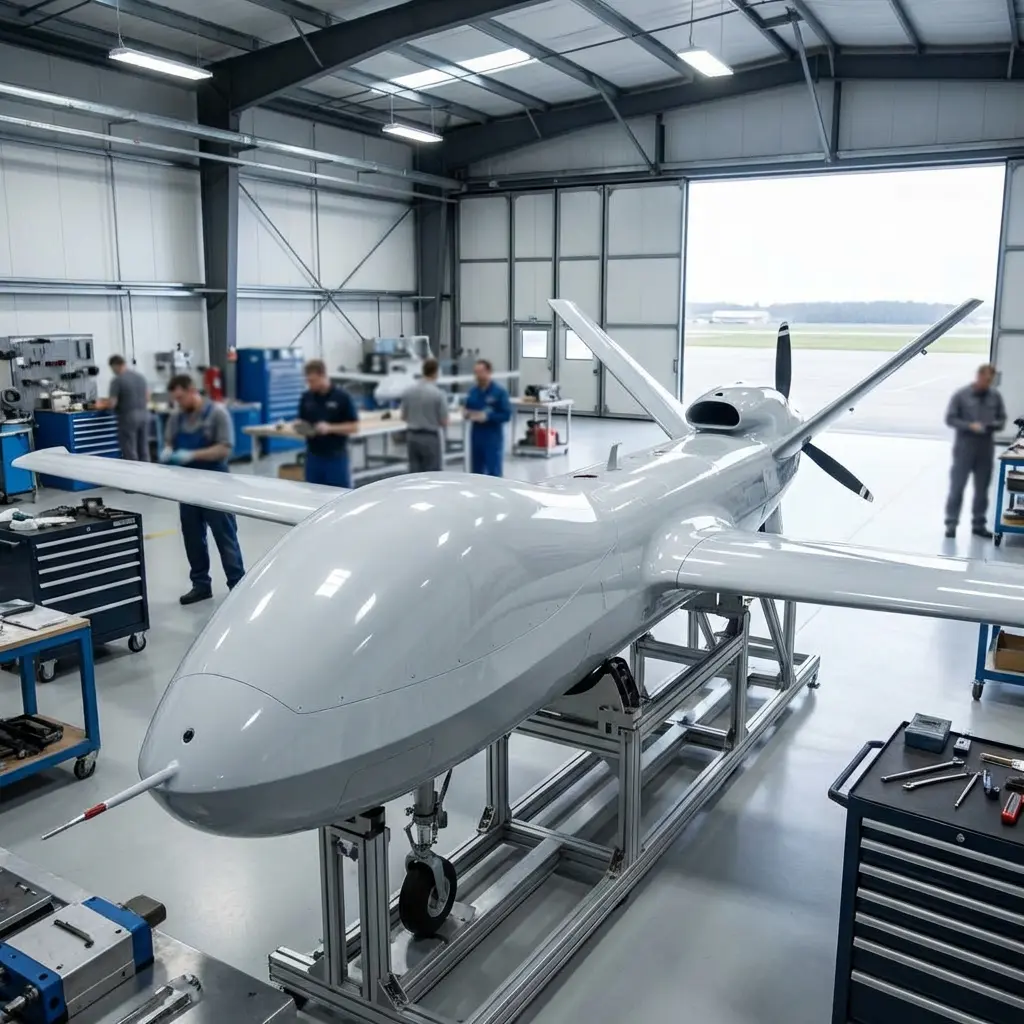
UAV Composite Materials Guide: Fuselage, Wings and NCF Fabrics
A UAV airframe is a stiffness-to-weight problem: the fuselage and wings must take torsion, gust loads and hard landings while leaving mass budget for batteries and payload. This guide covers UAV composite material choices for industrial drones and fixed-wing platforms — from ultralight ±45° biaxial NCF and carbon/glass hybrids to infusion, hand lay-up and prepreg process windows.
What Makes a Good UAV Composite Material?
UAV structures fail from buckling, torsional divergence and impact more often than from pure tensile overload. The useful figure of merit is specific shear stiffness, not just fibre tensile strength. That is why ±45° biaxial non-crimp fabrics outperform balanced woven rovings on fuselage shells and boom tubes: fibres sit straight, crimp is eliminated, and resin content can be driven down.
Secondary requirements are dielectric transparency (for GNSS and radio), surface quality for paint, and repeatable thickness so CG does not drift between airframes.
Fuselage, Wing and Boom: Matching Fabric to Load Path
• Fuselage / body panels — ±45° biaxial NCF (EBX 90-450 gsm) for torsion and shear. A light 0°/90° ply can be added where hard-point bearing is needed.
• Wings and tails — unidirectional or triaxial stacks along the spar cap; ±45° skins for torsion. Foam or honeycomb cores keep the skin stable in buckling.
• Booms and arms — tubular ±45° biaxial or triaxial wraps. Hybrid carbon/glass is common: carbon for stiffness, glass for impact and cost.
• Cowls and covers — chopped or light biaxial skins where the part is aerodynamic rather than primary structure.
Do not copy a carbon-fibre sports-drone stack onto a 25 kg industrial UAV. Impact, lightning and repairability change the laminate.
NCF vs Woven Roving vs Carbon Hybrid
Woven roving is cheap and drapable, but fibre crimp cuts compression and shear modulus — a problem on thin UAV skins. Non-crimp fabric (NCF) stitches layers of straight fibre, so a 200 gsm ±45° NCF can replace a heavier woven cloth at equal stiffness and come out ~40% lighter.
All-carbon stacks give the highest specific stiffness but raise cost, galvanic issues with aluminium fittings, and brittle impact behaviour. Glass or carbon/glass hybrid UAV composite material is usually the better production choice for industrial drones that must survive field handling.
For radome and antenna zones, glass remains mandatory: carbon shields RF.
Processes: Vacuum Infusion, Hand Lay-up and Prepreg
• Vacuum infusion — best quality/cost for series fuselages. NCF wets faster than woven cloth, reducing dry-spot risk in thin laminates.
• Hand lay-up — still used for prototypes and low-rate covers. Specify fabrics with a chopped or tissue face so wet-out is visible.
• Prepreg / out-of-autoclave — for high-rate or high-temperature UAV wings. Fibre architecture still matters; NCF prepreg reduces ply count versus woven prepreg.
Keep fibre volume fraction consistent. A 3-4% swing in resin content on a 2 m wing moves the empty weight enough to show up in endurance.
Design Notes for Industrial UAV Airframes
1. Start with torsion — size the ±45° skin first, then add 0° fibre only where bending demands it.
2. Protect edges — UAV skins are thin; peel-ply and glass tapes at hatches stop delamination in the field.
3. Inserts — use local 0°/90° build-ups under bolts rather than thickening the whole shell.
4. Lightning and EMI — glass skins with a mesh or foil where the airframe must stay RF-transparent except at bonded paths.
5. Repair — glass NCF is easier to patch in the field than brittle high-modulus carbon.
Zhongjie UAV Composite Fabrics
Zhongjie supplies ultralight ±45° biaxial NCF (EBX 90-450 gsm) and carbon/glass hybrid fabrics for UAV composite material programmes — fuselage shells, drone body panels, booms and fixed-wing skins. The fabrics are built for vacuum infusion, hand lay-up and prepreg, with fast wet-out and low areal-weight tolerance so airframe mass stays repeatable.
Open the UAV solution page for fabric codes, layup examples and sample requests.
More Technical Guides
EN 45545-2 Fire Safety Guide: Rail Interior Plastics vs Composites
Replace rail interior plastics with EN 45545-2 HL2/HL3 flame-retardant composites. Covers Brandschutz 45545, R1-R26 categories, FST testing, and GFK Brandschutz for Schienenfahrzeuge interiors.
Flame Retardant Battery Enclosures: Composites vs Aluminium vs Steel
Material guide for flame retardant battery enclosures and composite battery trays — aluminium vs steel vs glass-fibre composites, UL94 V-0 / GB 38031 / IEC 62619 fire standards, HP-RTM process, and weight comparison.
CIPP Liner Materials Guide: UV CIPP, Repair Fabrics and Wet-Out
Engineering guide to CIPP liner materials for trenchless pipe rehabilitation — UV CIPP fiberglass, CIPP repair fabrics, ECR-glass wet-out, DN200-DN3000 liners, DIN EN ISO 11296-4 and ASTM F1216.
Frequently Asked Questions
What is the best UAV composite material for a fuselage?
For most industrial drones, ±45° biaxial glass NCF in the 90-450 gsm range is the best starting UAV composite material: high torsional stiffness, low crimp, RF transparency and better impact behaviour than all-carbon skins. Add unidirectional or triaxial plies only on spars and hard points.
Why use biaxial NCF instead of woven roving on a UAV?
Woven roving crimps the fibres, which cuts shear and compression modulus. A non-crimp ±45° biaxial fabric puts straight fibre on the torsion load path, so the same stiffness is reached at lower weight — typically around 40% lighter than a comparable woven stack.
Can fiberglass replace carbon fibre on UAV wings?
On many industrial UAVs, yes for skins and secondary structure. Carbon still wins on spar caps where bending stiffness dominates. Hybrid laminates (carbon spar, glass skin) are a common production compromise for cost, impact and repair.
Which process is used for UAV fuselage production?
Vacuum infusion with NCF is the usual series process. Hand lay-up is used for prototypes; prepreg is reserved for high-rate or high-temperature wings. Fabric wet-out speed matters in all three.
What fabric weight is typical for a drone fuselage?
Ultralight UAV fuselage shells commonly use 90-300 gsm ±45° biaxial NCF, with local 400-800 gsm build-ups at landing-gear and payload hard points. Exact gsm depends on airframe size and crash requirements.